
FlightPath3D Expands Leadership and Operations to Support Growing Demand Across Commercial and Business Aviation
Senior executive hires strengthen commercial reach and product innovation
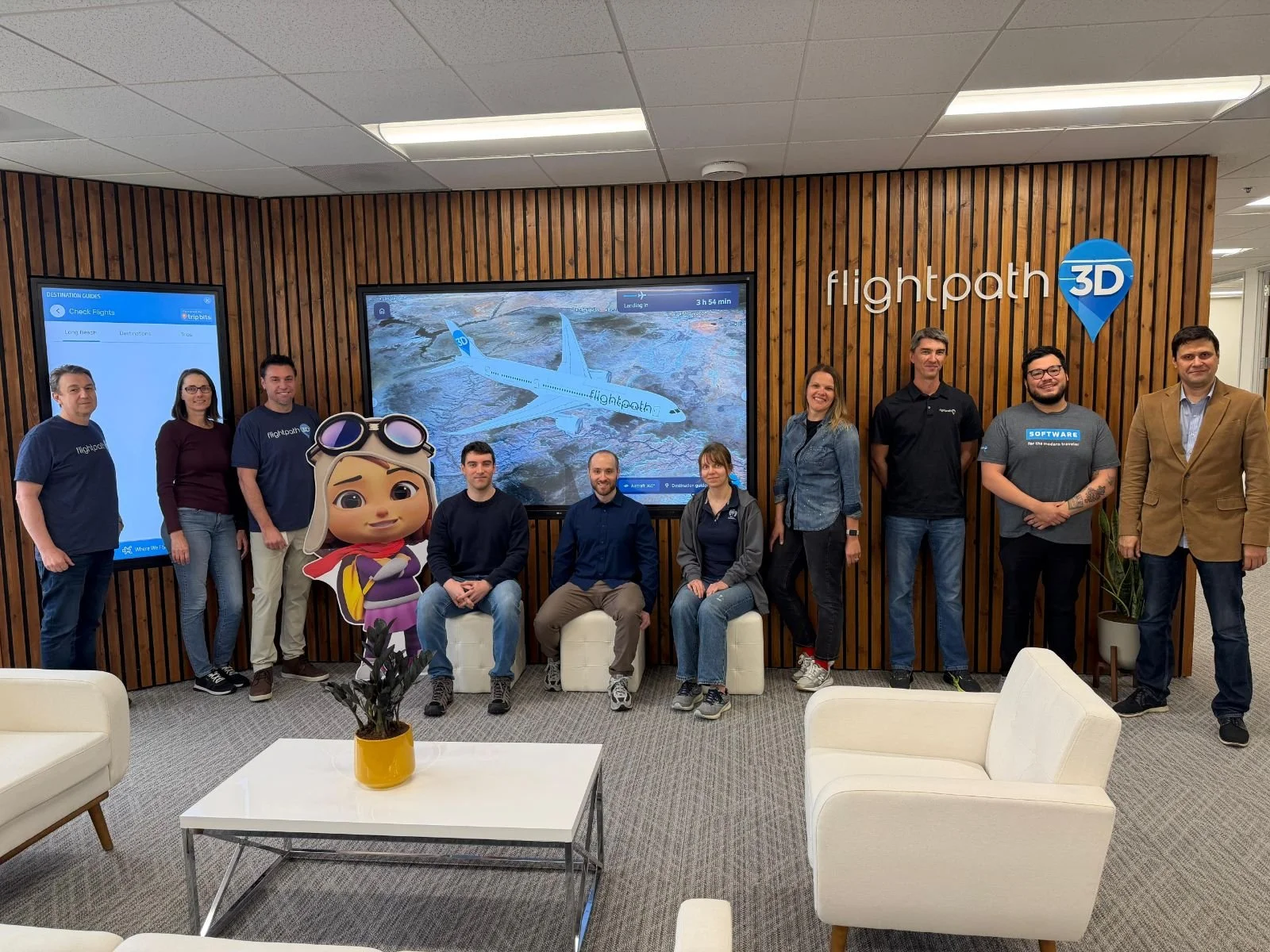
[Irvine, California, March 12, 2026] — FlightPath3D, the aviation industry’s leading provider of immersive inflight maps, has added senior commercial and product leaders while expanding its operational footprint to support increasing global deployments across commercial and business aviation.
With more than 5,000 commercial aircraft and over 1,500 business and government aircraft deployed worldwide, FlightPath3D continues to scale its award-winning inflight map platform — one of the most widely used digital touchpoints onboard.
“The inflight map remains the foundation of our company, but the opportunity ahead is far broader,” said President Duncan Jackson. “We are building intelligent capabilities around that core experience, backed by broad data resources and AI-driven analysis, to strengthen how airlines and operators engage passengers throughout the journey.”
Leadership Expansion
To support continued innovation, FlightPath3D added senior leaders across commercial aviation, business aviation, and product management.
FlightPath3D now provides dedicated sales and account management in the Middle East with the hiring of Prashant Vyas as Vice President, Middle East. Vyas brings senior leadership experience across the global IFE and connectivity ecosystem to the company, including roles at Thales, Safran Passenger Innovations, and Panasonic Avionics. He has led complex airline technology programs across key international markets and built long-standing relationships with major carriers and aviation stakeholders.
Vyas’s responsibility includes regional growth and strategic airline partnerships through customer-focused solutions and market-led execution as FlightPath3D expands globally.
Howie Lewis joins as Vice President of Business Aviation, bringing extensive inflight and connectivity experience, including leadership roles at Gogo, Airshow, and EMS Satcom. He has worked closely with OEMs, completion centers, and operators to deploy and scale onboard solutions across premium fleets worldwide. Those relationships will continue to expand as FlightPath3D integrates new features into its map platform, already deployed on a broad range of business and government aircraft across multiple technology platforms.
Artificial intelligence integration is a critical growth area for FlightPath3D. Now driving that effort is Ross Derham, who joins as Director of Product Management. Derham brings significant experience across aerospace and immersive 3D platforms, including Boeing and Meta. He previously led development initiatives spanning real-time 3D systems, enterprise software, and operational technologies within complex environments. He will support continued innovation and scalability for FlightPath3D’s interactive and AI-enhanced map platform.
Office and Operational Expansion
FlightPath3D expanded its engineering operations in Portugal in 2025, followed by an early 2026 move of its Irvine, California headquarters. The new facility more than triples the available space and includes engineering labs and client collaboration areas, supporting product development, client-driven innovation, and customer demonstrations.
The growing engineering team supports the company’s ongoing efforts to expand what can be done with the inflight map.
“We are constantly pushing boundaries on what is possible with the inflight map experience and are committed to continuing that innovative streak,” explains CEO Boris Veksler. “Our expanded facilities and strengthened executive bench ensure we can meet the evolving needs of airlines, business aviation operators, and OEM partners worldwide.”
Building on an Award-Winning Foundation
FlightPath3D’s award-winning inflight map remains the core of the platform, recognized for its immersive 3D visualization and passenger engagement. Recent enhancements build on that foundation, including the award-winning Kids Map and Accessibility Map, as well as new capabilities such as Destination Stories and Luci, the company’s AI-powered digital flight companion.
The new Cloud Map architecture further positions the company for expansion with additional airlines. Its build-once, deploy everywhere architecture and light-touch implementation approach enable rapid adoption, even on airlines without an IFE system installed. The expanding in-house support and engineering teams strengthens those efforts.